by Emma, Editor of Bolsover Cruise Club’s Into the Blue magazine
Like many, I’ve often found myself drawn to Spain’s sun-soaked southern coastlines. You know, those tried and trusted Costas, with their promise of endless sunshine, chilled sangria, and the kind of effortlessness that comes with anywhere steeped in familiarity. But Northern Spain? Well, that’s a little more of an unknown.
Still, I’d heard nothing but positive things about this lesser-known seaboard of a country I thought I knew so well. Not one to let a good travel tip go to waste, I couldn't wait to forge my own conclusions. Northern Spain might not have the bullishness of Barcelona or the metropolitan swagger of Madrid, but therein lies its appeal. So, armed with curiosity and a few well-placed travel tips, I set off to discover this quieter, quirkier side of Spain.
And this is where Fred. Olsen came in. Firmly domiciled in the north of England, there is something of a novelty factor about not having to sail from Southampton. As luck would have it, there was a cruise on board Bolette that departed from Liverpool, which meant I could sail to Northern Spain without having to go anywhere near the M40. Destined for a trio of Spanish ports – Getxo (the gateway to Bilbao), Gijon and La Coruna – the decision was a no-brainer. Bags swiftly packed (and taking full advantage of the ultimate benefit of cruising from the UK: being able to take multiple pairs of shoes), it was time to set sail for Spanish shores.
We’re off to (SUNNY?) SPAIN…
When you sail with Fred. Olsen, it’s abundantly clear where in the world you’re sailing to. This might seem like an odd observation, but bear with me. Where the smaller ship cruise line holds its own is by really bringing a destination to life, even before you’ve set foot on those foreign lands. For us, this came in the form of onboard lectures, culinary nods to the region and destination guides that would even leave Lonely Planet shaking in its boots.
It’s at this point I should hold my hands up and say that onboard talks are not my usual entertainment of choice on a cruise ship; whether they’re a little too reminiscent of the hours spent in university lecture theatres, I’m not sure. But, heart firmly set on learning more about Northern Spain, I made my way to the Neptune Lounge.
The presentation, titled ‘10 Things You Might Not Know About Northern Spain’, was delivered by Arantxa Sardina, a Santander native with an evident passion for her region. “Great!” I thought to myself – this would surely tick off some of those niggling questions I had about this part of the world. And it most certainly did; I’m happy to report that the talk firmly lived up to its title and most certainly taught me 10 things I didn’t know about Northern Spain.
As the week-long cruise unfolded, the ports we visited somehow gained more meaning, and there were plenty of points of reference from Arantxa’s presentation. The crayon-coloured houses that greeted us around Bilbao’s Old Port were each painted to match the hue of the owner’s boat, so they could easily be identified from the sea. Local folklore also has it that this ingenious colour-coding helped local fishermen return to the right house after a few drinks at the bar! Without attending the talks, these small points of interest would quite easily have escaped my notice – as the saying goes, you learn something new every day. And, much to my delight, there was no exam at the end.
Fred. Olsen’s homage to our destination didn’t end there. The main restaurant served Spanish classics throughout our cruise, ranging from the obligatory paella to the more niche migas, which divides opinion in much the same way as Marmite. So far, so good!
Shoreside exploration,
WITH A SIDE OF CIDER
After two wonderfully leisurely sea days, we reached Northern Spain. Our first port of call was Bilbao, or more specifically, the town of Getxo (which, thanks to the lecture, I discovered is pronounced ‘get-cho’), where Bolette docked.
A free shuttle bus took us straight into the centre of Getxo, where we hopped aboard a local Metro service and found ourselves in the heart of the city in no time. This was the only port of call where we’d decided to ‘go it alone’ – and, let’s face it, there was only one place we were ever going to visit: the Guggenheim Museum Bilbao. This futuristic building was impressive, and the fact that the nearby streets were dotted with pintxos bars bathing in the mid-October sunshine only made our time here even more memorable. As far as first impressions go, Northern Spain was up there with the best.
Next on our foray across Spain’s Atlantic coastline was Gijon (pronounced gee-hon - told you I learnt something!), a place I must admit I knew little to nothing about. Fully intent on tackling the capital of Asturias head-on, I decided to let Fred. Olsen take the reins and booked an excursion. I’m usually a bit of a free spirit and like to wander, but at face value, this trip seemed to offer a perfect blend of self-exploration and guided insights.
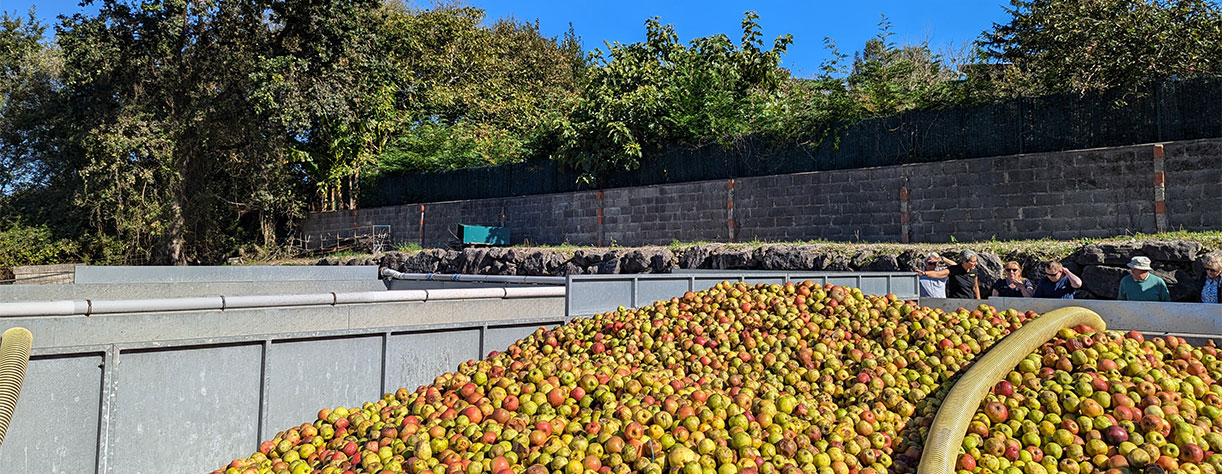
We enjoyed a short walking tour followed by some free time in the city, before heading out to Llagar Sidra Castanon, a third-generation cider house on its outskirts. OK, I should probably backtrack and admit that the prospect of seeing cider being produced and sampling its wares may have played a part in my choice of excursion - the selection of other Gijon-specific experiences was just a bonus.
It’s fair to say you probably wouldn’t stumble upon Llagar Sidra Castanon if left to your own devices; surrounded by rolling hills and spectacular scenery, we were guided around the cider factory, where traditional methods are still very much at play. This was followed by a tasting among the cider barrels, and anyone who has ever been to Northern Spain will tell you that pouring cider is something of an art form. The glass is tilted at a distance from the tap, and somehow culminates in a perfect serve; the reward for such a gravity-defying moment is a crisp glass of Asturias’ finest, made better only by a selection of complementary local cheeses.
Had my day ended here, I would have been more than content. But Fred. Olsen had one more stop in store before returning us to the ship. The Universidad Laboral de Gijón is a vast building – the largest in Spain, we were led to believe – and was originally commissioned by Franco. It’s another place that you wouldn’t stumble across without venturing just that little bit further outside Gijon, and I’m glad we spent a short time exploring it en route back to Bolette.
Our last port of call was La Coruna, where once again, we ventured ashore with Fred. Olsen’s incredible local guides. After visiting a couple of Northern Spain’s bigger cities, we were keen to visit somewhere a little different. Our excursion of choice, A Taste of Betanzos, took us on an early-morning coach tour around the city, including a stop at the Tower of Hercules, before weaving our way eastwards to the municipality of Betanzos.
One of the main appeals of this particular outing was a visit to a local cheese maker, which was housed in a tiny shop tucked down one of Betanzos’s many cobbled streets. Forget fancy machinery, this was the real deal, with a local woman using nothing more than her hands, a large bowl and a sieve to create the regional speciality. You quickly learn to trust in the process when it comes to these things, and it’s safe to say the finished product was nothing short of delicious.
A secret
Worth Sharing
Northern Spain represents Europe as its most rugged, authentic self… and it seems there are few cruise lines better equipped to acquaint you with the region than Fred. Olsen. Your meeting will extend far beyond simply stepping ashore for a few hours; the destination is as omnipresent on board as it is on land, delivered with all the style and finesse that I've come to expect from this smaller-ship cruise line.
I’d urge anyone to swap sangria for cider, and Gaudi for Guggenheim, if only to be among the first in line to see what all the fuss is about. Because I’m willing to bet this part of Spain won’t stay secret for long.
Read more from The Bridge
A Sweet Celebration
Entertainment
Latest News